Today, most businesses prefer to offer their customers various payment options and gain advantages in payment expenses in their online payment processes. Businesses that accept online payments have many options in this regard: Bank virtual POS terminals, Payment Service Providers (PSP), or Payment Orchestration Platforms.
In this article, we will define the concepts of payment gateways and payment service providers and answer the critical question: “What are the differences between a payment gateway, payment orchestration, and a payment service provider?”
Payment Methods for Businesses to Use in Online Payments
Let’s take a closer look at the various channels you can use for online payment processes while discussing the diversity of channels for accepting payments online:
Bank Virtual POSs
Bank virtual POSs are digital software systems banks develop that enable businesses to collect payments. Virtual POSs can be integrated into a business’s website, allowing users to shop and complete payment transactions.
Each bank has a different process for providing virtual POS for online payments. To use bank virtual POS terminals for online payments, you must complete separate commercial agreements with each bank.
Payment Service Provider
Payment service providers, frequently used by businesses engaged in online product or service sales, ensure that online payment transactions occur. In our country, these systems are regulated according to specific licenses, standards, and legal regulations.
The concept of payment service providers, or payment institutions, consolidates different bank virtual POS terminals under a single umbrella. In other words, a payment service provider makes agreements with banks on behalf of businesses, enabling them to access multiple bank virtual POS terminals simultaneously. To work with a payment institution, you must apply to the relevant organization and make a commercial agreement.
You can have agreements with bank POS and payment service providers for online payments. However, managing multiple payment methods individually can be time-consuming and operationally challenging. To overcome this, you can utilize a Payment Orchestration Platform.
Thanks to the payment gateway capability embedded within the platform, you can technically integrate all your bank virtual POS terminals and payment institutions from a single panel. However, mere connectivity is often not enough. Especially as your transaction volumes increase, Payment Orchestration becomes essential. Unlike standard gateways, an orchestration platform allows you to use features like Smart Routing to direct payments through the most advantageous virtual POS. This capability is critical for high-volume businesses to reduce payment expenses and gain a competitive operational advantage.
Alternative Payment Methods
Alternative payment methods refer to non-traditional payment methods other than credit cards, debit cards, or prepaid cards. Alternative payment methods include e-money, e-wallets, meal vouchers, transportation cards, and more. Examples of commonly used alternative payment methods in Turkey include GarantiPay, Sodexo, and Edenred. For more detailed information on the payment methods you can use for your online payments, please read our article.
What Is a Payment Service Provider and How Does It Work?
Payment service providers (PSPs) are the systems that facilitate the collection of payments and the completion of collection processes through financial institutions.
The starting point of the payment service provider concept is to bring together various bank virtual POSs under a single organization. These systems have already made agreements with banks on your behalf. Therefore, you only need to pay a commission to the relevant organization.
Payment service providers enable businesses to connect to bank virtual POS terminals and ensure the payment process follows their designated routing rules. The working principle of payment service providers is based on matching the buyer’s card information with the seller’s information for the products and services purchased.
What is a Payment Gateway and How Does It Work?
A Payment Gateway is a technical bridge that allows you to manage your business’s online payment connections from a single point. It enables a company to integrate with bank virtual POS and payment service provider systems securely.
However, a Payment Gateway is not a payment service provider; it does not issue virtual POS or hold money. It is simply the secure pipeline for data.
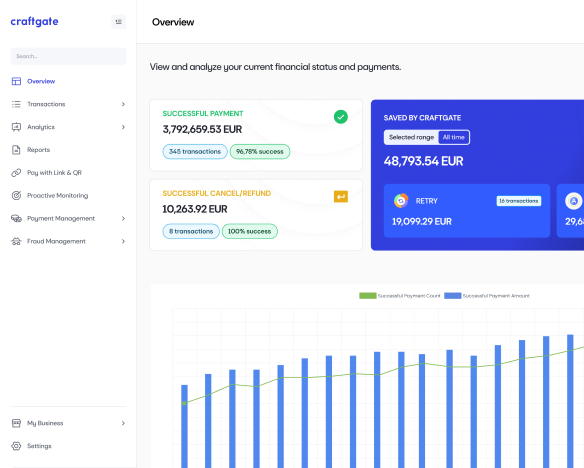
While a payment gateway provides connectivity, a Payment Orchestration Platform (like Craftgate) adds a layer of intelligence. It manages the entire payment lifecycle, offering features like smart routing, failover, and consolidated reporting.
You can find more detailed information about payment gateways, their usage areas, and their advantages here.
Which are the Most Preferred Payment Service Providers?
As we mentioned before, there are many options you can use in your online payment processes. For your business to receive online payments, you can apply to banks for a virtual POS, or you can apply to payment service providers. It is important to remember that the agreement processes and conditions of each organization are different from each other.
Payment Gateway and Payment Service Provider Differences
The concepts of payment gateway and payment service provider are entirely different in nature and function.
- Payment Gateways: Do not issue virtual POS and do not collect/send money. They provide financial freedom with a single technical integration. Your online payments pass through the gateway infrastructure to reach the bank.
- Payment Service Providers: Are financial institutions that collect and distribute money.
Businesses can quickly realize technical integrations of bank virtual POS, payment service providers, or alternative payment methods using a payment gateway infrastructure. The point to be noted here is that the integration in question is technical. Therefore, to include a bank or payment service provider in your system through the gateway, you must have a commercial agreement with the relevant payment method.
Why Orchestration Matters Here? Standard payment gateways can also offer additional services. However, Payment Orchestration platforms take this further. For example, Craftgate offers 21 different solutions that allow merchants to continue accepting payments 24/7, even in case of virtual POS downtime (Autopilot), preventing them from experiencing a loss in turnover. Craftgate also helps member businesses reduce payment expenses by ensuring that payments go through the most advantageous virtual POS terminal via Smart Routing.
You can check out Craftgate’s Payment Orchestration features and our value-added services here.
You can also send your questions to info@craftgate.io for more detailed information.