In the world of digital commerce, money rarely moves in a straight line. A single customer payment can involve multiple systems such as checkout platforms, payment processors, banks, and accounting software. Each of these systems records its own version of the transaction.
This is where reconciliation becomes essential.
Reconciliation ensures that all financial records match across systems. It verifies that payments processed, funds received, and accounting records all align. Without reconciliation, businesses risk inaccurate financial reporting, unnoticed errors, and limited visibility into their cash flow.
For companies managing online transactions, understanding reconciliation is fundamental to financial management.
What Is Reconciliation?
Reconciliation is the process of comparing two or more sets of financial records to confirm that they match.
In accounting, reconciliation typically involves verifying that internal records align with external financial statements, such as bank records or payment reports. The purpose is simple. It ensures that financial data is accurate and complete.
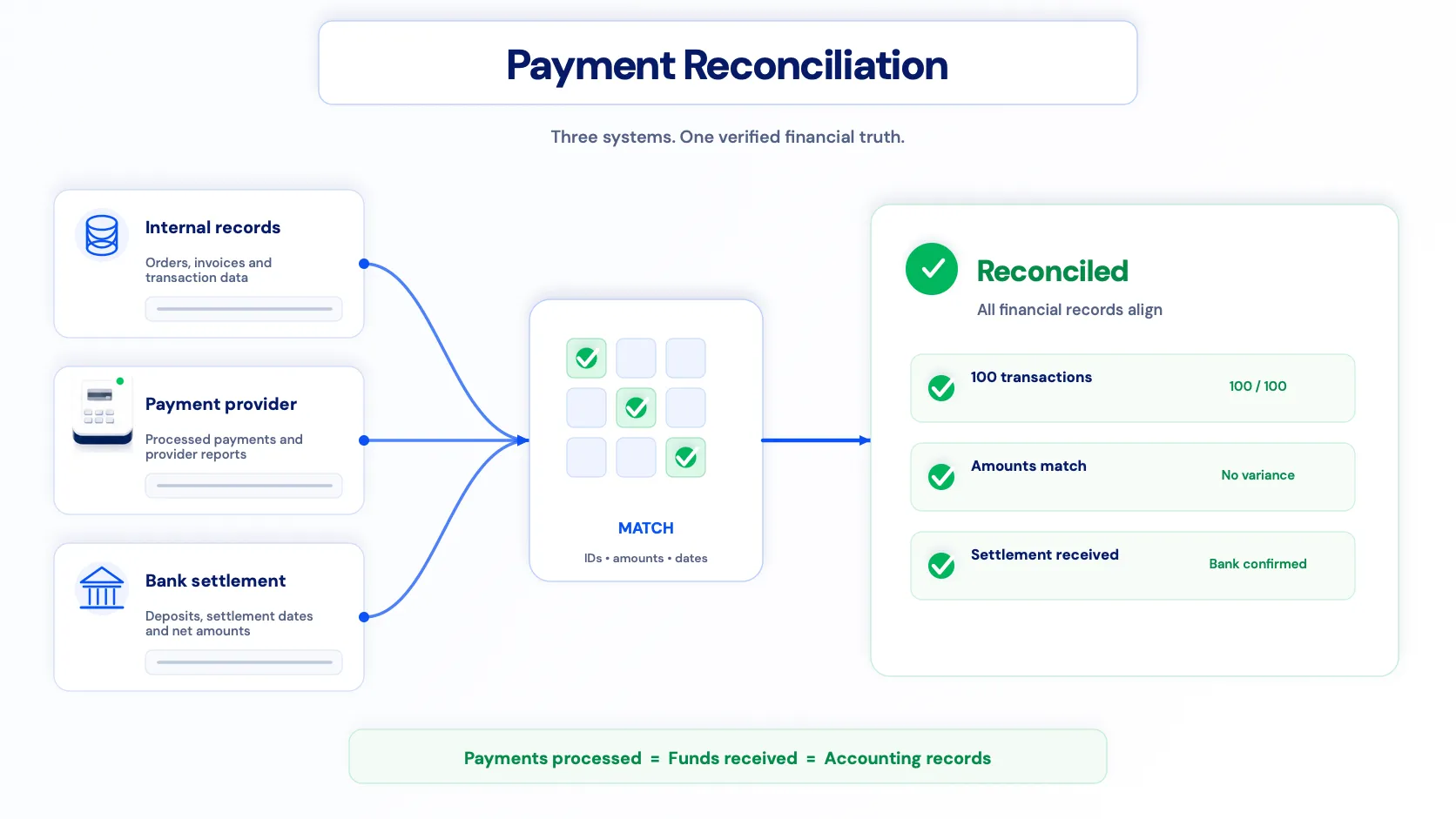
When applied to online payments, reconciliation usually means comparing:
- Internal transaction records
- Payment processor or gateway reports
- Bank deposits or settlement reports
If all records match, the transactions are considered reconciled. If discrepancies appear, they must be investigated and resolved.
In essence, reconciliation acts as a financial checkpoint that confirms money has moved exactly as expected.
What Is Payment Reconciliation?
Payment reconciliation is a specific type of reconciliation that focuses on verifying digital payment transactions.
In this process, businesses confirm that the payments recorded in their internal systems match the transactions reported by payment providers and the deposits appearing in bank accounts.
For example, if an online store records 100 payments in its order system, reconciliation ensures that:
- The payment processor confirms those transactions
- The correct amounts were processed
- The expected funds were deposited into the bank
Payment reconciliation connects these records to ensure consistency across systems.
Why Reconciliation Matters for Businesses
Reconciliation plays a critical role in financial operations, particularly for businesses that handle high volumes of online payments.
1. Ensures Financial Accuracy
One of the main goals of reconciliation is ensuring that financial records are accurate. When transactions are reconciled regularly, businesses can confirm that their accounting systems reflect real financial activity.
This helps prevent incorrect revenue reporting, missing transactions, or duplicated records.
2. Identifies Errors Quickly
Payment systems involve multiple steps, and errors can occur at different stages, such as processing, settlement, or record keeping.
Reconciliation helps identify issues such as:
- Missing payments
- Duplicate transactions
- Incorrect payment amounts
- Unrecorded processing fees
Detecting these problems early allows finance teams to resolve them before they affect financial reporting.
3. Improves Financial Transparency
Regular reconciliation gives businesses a clearer picture of their financial activity.
By confirming that transactions match across systems, organizations gain confidence in their financial data. This transparency supports better decision-making, budgeting, and long-term planning.
4. Helps Detect Fraud or Irregular Activity
Another important benefit of reconciliation is identifying unusual or unauthorized transactions.
If payments appear in one system but not another, or if amounts do not match expected values, reconciliation helps flag those discrepancies for investigation.
Why Reconciliation Is Critical in Online Payments
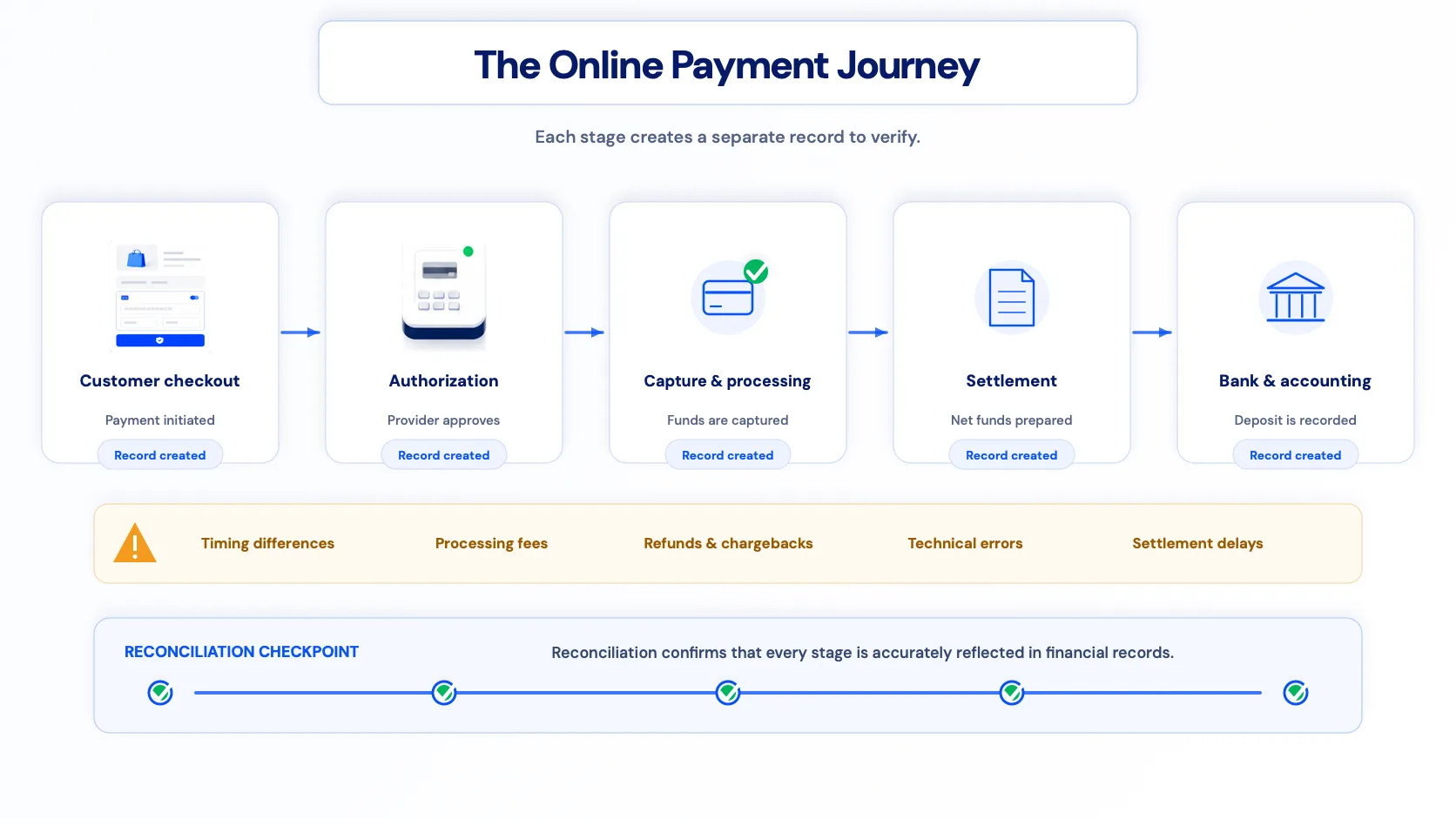
Traditional accounting reconciliation has always been important, but online payments add additional complexity.
A single online transaction may pass through several stages:
- A customer initiates a payment on a website or app
- A payment processor authorizes the transaction
- The payment is captured and processed
- Funds are settled and transferred to the business’s bank account
Each stage creates its own records.
Because these systems operate independently, discrepancies can occur due to timing differences, technical errors, refunds, or processing fees.
Reconciliation ensures that every stage of the payment journey is accurately reflected in financial records.
The Payment Reconciliation Process
Although processes vary between organizations, most reconciliation workflows follow a similar structure.
1. Collect Financial Data
The reconciliation process begins by gathering records from different sources.
These typically include:
- Internal payment records
- Invoice or order data
- Payment provider transaction reports
- Bank settlement reports
Having complete data from each system is essential for accurate reconciliation.
2. Match Transactions
Next, finance teams compare transactions across systems.
Matching typically involves verifying information such as:
- Transaction IDs
- Payment amounts
- Dates and timestamps
- Customer references
The goal is to confirm that every internal transaction corresponds to a processed payment and a bank deposit.
3. Identify Discrepancies
If records do not match, discrepancies must be identified.
Common reconciliation differences include:
- Missing transactions
- Duplicate entries
- Delayed settlements
- Processing fees affecting final amounts
- Refunds or chargebacks
- Commission differences between expected and applied rates
Identifying these differences not only supports accurate reconciliation but can also reveal commission inconsistencies and contribute to payment optimization by highlighting potential cost inefficiencies. These differences require further investigation. These differences require further investigation.
4. Investigate and Resolve
Once discrepancies are identified, finance teams determine their cause and correct the records if necessary.
This might involve adjusting accounting entries, verifying payment processor reports, or reviewing settlement timelines.
By enabling teams to detect and resolve issues more efficiently, reconciliation also supports smoother operational processes and contributes to improved customer satisfaction.
5. Finalize the Reconciliation
After discrepancies are resolved, the reconciliation process is finalized and documented.
Keeping reconciliation records helps create an audit trail and supports regulatory compliance.
Common Challenges in Reconciliation
While the concept of reconciliation is straightforward, executing it can be challenging, especially for companies with large transaction volumes.
Some common difficulties include:
- High transaction volumes: Businesses processing thousands of daily payments may struggle to reconcile transactions manually.
- Multiple payment methods: Different payment types, such as cards, digital wallets, and bank transfers, often generate separate reports.
- Settlement delays: Payments may be recorded instantly but deposited days later, which makes reconciliation more complex and can also create challenges for maintaining accurate and timely accounting records.
- Fees and adjustments: Payment processing fees, currency conversions, and chargebacks can complicate transaction matching.
These challenges explain why reconciliation processes often evolve as businesses grow.
The Role of Automation in Reconciliation
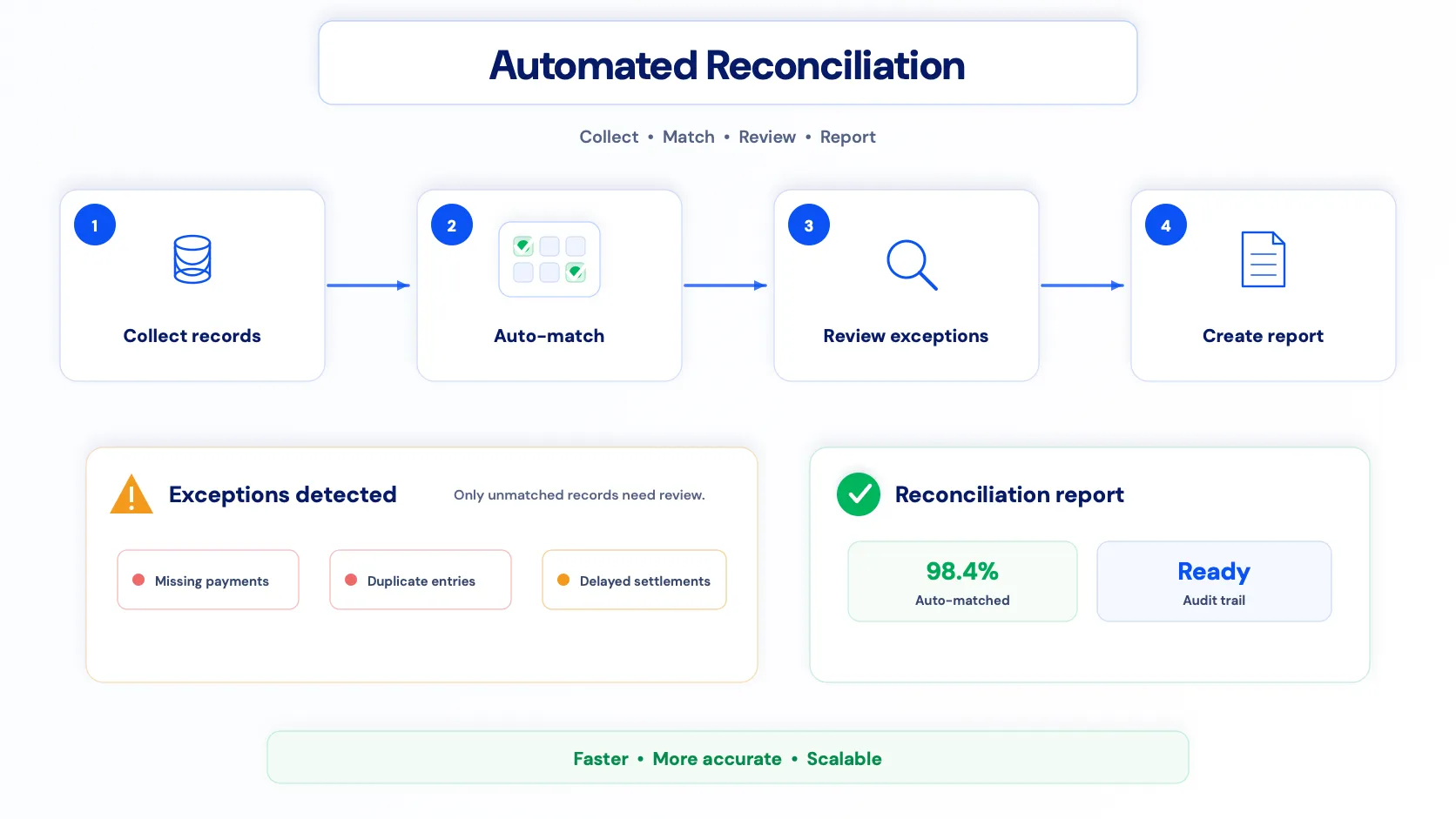
Many organizations begin with manual reconciliation using spreadsheets. However, as payment volumes increase, manual processes become inefficient and prone to error.
Modern reconciliation tools can automate many steps of the process. These tools can:
- Import transaction data from multiple systems
- Automatically match payments
- Identify discrepancies
- Generate reconciliation reports
Automation reduces operational workload while improving both accuracy and speed.
For businesses that manage large volumes of digital payments, automated reconciliation can significantly streamline financial operations.
Final Thoughts
Reconciliation is a fundamental practice in financial management. It ensures that financial records accurately reflect real payment activity.
For businesses operating in the digital payments ecosystem, reconciliation plays an even more important role. It connects transaction data across multiple systems, verifies that payments are correctly processed, and provides confidence in financial reporting.
As digital payments continue to grow, maintaining a robust reconciliation process is essential for building reliable, scalable payment operations.