In today’s rapidly advancing technological landscape, a wave of innovation has significantly impacted the financial sector. The term “FinTech,” a fusion of “finance” and “technology,” encompasses products and services that are reshaping how we manage money. In this article, we will explore the applications of financial technology, the evolution from simple payments to complex orchestration, and insights into the future of the FinTech ecosystem.
Which Companies Operate in the FinTech Sector?
The number of companies offering products and services in this sector is growing daily. Both in Turkey and globally, the ecosystem continues to draw attention due to technological advancements and high-value investment deals.
Recently, we’ve witnessed the emergence of numerous new players in the financial technology sector, ranging from digital banks (Neobanks) and personal investment apps to Payment Orchestration Platforms and cryptocurrency exchanges.
Prominent global examples include Klarna, Stripe, Wise, Revolut, Nubank, and Plaid. Notably, tech giants like Apple, Google, and Amazon have also made significant investments, often acquiring emerging startups or developing their own FinTech solutions to strengthen their positions.
What Are the Functional Benefits and Use Cases?
Financial technology products offer solutions to the slow and complex nature of traditional banking. With specialized software and algorithms, they assist businesses and end-users in managing financial operations more efficiently.
FinTech solutions have numerous use cases for businesses. An excellent example is visible in payment processes. Many financial technology players contribute to the crucial payment stage of the online shopping experience. It’s essential to understand that players’ roles in the payment stage can evolve based on changing needs. For instance, in the past, the only way online businesses could receive payments was to apply for virtual POS terminals from banks. Over time, payment service providers emerged, allowing businesses to accept payments from multiple bank virtual POS terminals for a set commission fee. They acted as a bridge between banks and businesses.

As businesses grew and their online payment volume increased, simple connectivity wasn't enough. They needed intelligence to optimize costs and success rates. This led to the rise of Payment Orchestration Platforms. Unlike standard gateways that just connect, Orchestration platforms manage the entire lifecycle, routing payments to the best provider and ensuring backup during downtimes.
Financial technology products also provide practical solutions to end-users financial needs in their daily lives, including
- Digital banking applications for executing banking services like money transfers and currency exchange.
- Contactless payment methods provide alternatives to traditional cash or card payment methods.
- Alternative payment methods are used online or in-person shopping or within loyalty card programs to earn points.
- Investment applications that enable managing personal investments through a single platform.
- Blockchain applications for accessing cryptocurrency exchanges.
What Are the Advantages of FinTechs?
Using financial technology products to simplify financial processes offers several advantages for both consumers and businesses. These advantages can be summarized as follows:
- Digitizes business processes and reduces operational costs.
- Allows the use of smartphones as digital wallets.
- Enables financial transactions independent of time and place.
- Speeds up and simplifies financial transactions.
- Minimizes expenses related to physical processes.
- Provides a personalized financial service experience for end-users.
- Reduces time wasted on financial processes for businesses, thus cutting down on costs.

What Features Should FinTechs Have?
As mentioned before, FinTech solutions were born to address the shortcomings of traditional financial practices. Consequently, the primary feature expected from a FinTech application is to make any financial process more straightforward. In addition to advanced product technology, specialized expertise in a specific field is considered an essential parameter. For example, a tax payment application is expected to deeply understand tax law, while a personal investment service should know about investment.
The same principle applies to the payment sector. Businesses expect the products they entrust with their online payment processes to have expertise in this field.
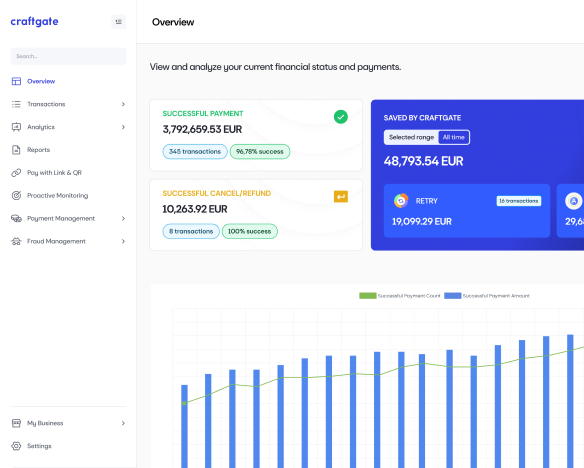
In this regard, as Craftgate's Payment Orchestration Platform, we provide our member businesses with high-quality product technology. We leverage our extensive experience and knowledge in the payment sector to help businesses enhance their payment processes and grow. You can read feedback from our merchants about their Craftgate experience here.

Global FinTech Statistics
The usage of financial technology products is increasing worldwide, making FinTech one of the popular sectors in terms of investment and deal value. To better understand this trend, we’ve compiled global FinTech data based on research conducted by companies like EY, Index, CB Insight, Accenture, Statista, and Forbes:
- The FinTech market is expected to exceed $37 billion by 2026.
- In 2019, it was found that 64% of the global population had used at least one FinTech application.
- As of 2022, the Nasdaq lists 49 financial technology companies.
- In the first quarter of 2022, the total number of global finance deals in the FinTech sector increased by 20% compared to the first quarter of 2021, reaching 1,482 deals.
- As of 2021, there were over 10,000 registered financial technology startups in the United States and over 26,000 globally.
- In the third quarter of 2022, there were 24 investment agreements in the FinTech sector in the United States, with a total investment of $737.4 million.
- As of November 2022, the financial technology sector became the second most invested sector in the MENA region, following FoodTech.
Regulations in Financial Technologies
The financial technology sector is subject to strict regulations in Turkiye and worldwide. Fast-developing innovations bring about regulatory rules to meet the changing needs.
Regulations related to this sector in Turkiye include Law No. 6493, relevant communiques and regulations, the Banking Law, digital banking regulations, open banking, QR codes, FAST regulations, and more.
What Does the Future Hold for the FinTech Sector?
If you’ve had even a slight encounter with financial technologies, you’ve likely heard the phrase: “Every company will one day become FinTech.” It might be challenging to say that this has completely come true today. However, it’s evident that producing these technologies in-house can be challenging and costly for businesses aiming to meet their financial needs. At this point, ready-made FinTech products are lifesavers for businesses looking to streamline operational processes, reduce costs, or enhance the customer experience. Financial sector players like banks also show significant interest in FinTech applications within their organizations or by supporting financial technology products in their incubation centers through acceleration programs or funding.
FinTech remains focused on end-users as well. In a rapidly changing world where technology advances quickly, each new generation is shaping its habits. Banking transactions and payment habits have also evolved in this new era, as in many other areas. Many banks in Europe and around the world have announced a reduction in the number of their branches. Cash usage has decreased. In addition to card payments, mobile and contactless payments have become a standard part of our lives.
In summary, in the future, the lines separating banking, finance, insurance, fund management, and other related sectors will become increasingly blurred. In other words, financial technologies will play a more significant role in our lives.
If you want to enhance your business’s payment processes with an advanced Payment Orchestration experience, please don’t hesitate to contact us.