Understanding payment systems starts with knowing who is involved, what the different payment instruments do, and how a transaction moves through its stages. Card schemes, issuers, acquirers, payment providers, and technical platforms each have a role in the merchant's payment setup.
This guide brings the fundamentals and commonly used definitions together. It covers card types and details, payment acceptance, authorisation and capture, security, commercial terms, and the technical services used to manage payments. Türkiye-specific concepts are identified in their local context.
What Are Payment Systems?
From a merchant's operational perspective, payment systems include the instruments, provider connections, devices, software, and processes used to accept and manage payments in physical and online environments. Physical acceptance may involve a POS terminal, while online acceptance uses software interfaces connected to banks and payment service providers.
For online card payments, a merchant may establish bank virtual POS connections, work with payment service providers, or combine these options according to its agreements and business needs. Alternative methods and wallets can extend the payment choices available to customers.
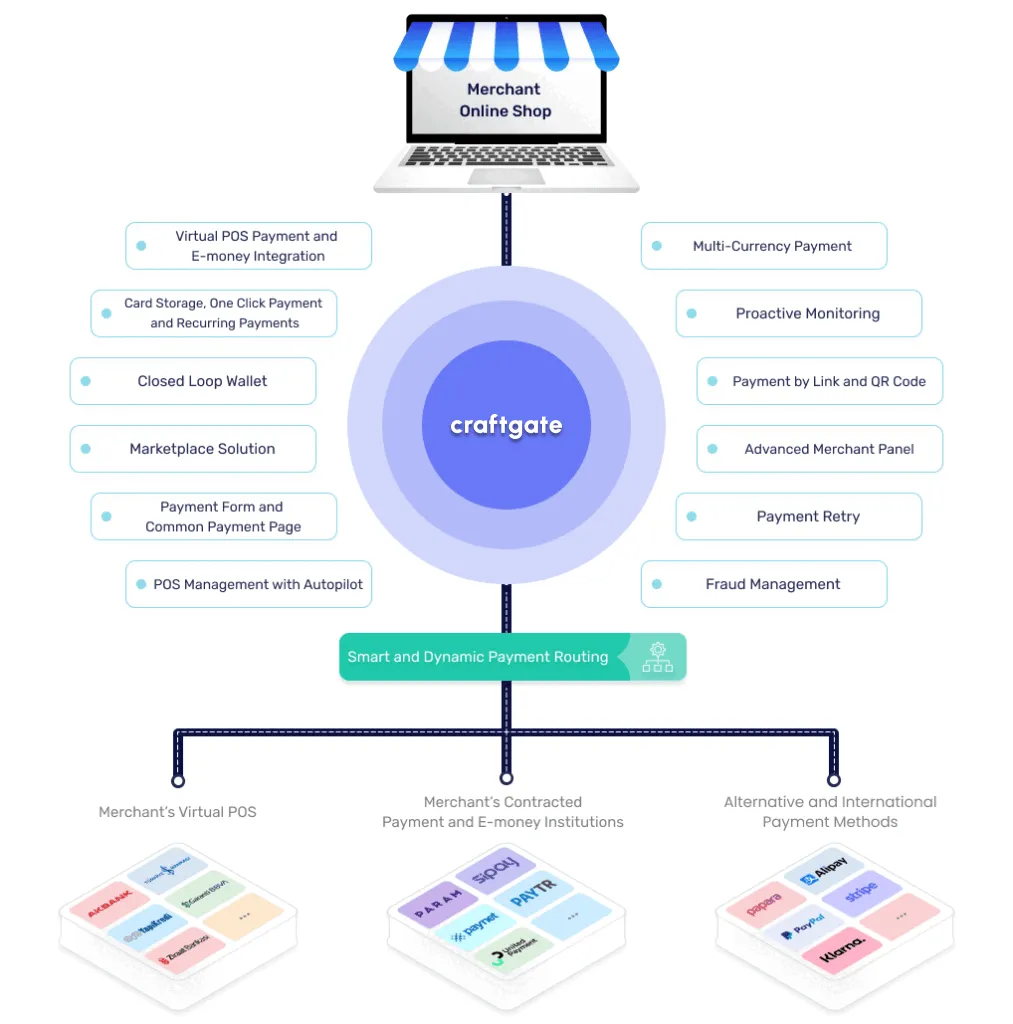
As the number of connections grows, a payment orchestration platform can help coordinate the technical integrations and payment operations from a single point.
Participants, Card Schemes, and Card Families
Merchant
A merchant is a person or business that sells goods or services and accepts payment. Its acceptance setup may involve a bank, an authorised payment service provider, or other supported provider arrangements. The merchant's role is broader than ownership of a particular POS device.
Cardholder
The cardholder is the person to whom a payment card is issued or who is authorised to use it under the issuer's terms. The cardholder's details are associated with the card account and may appear on the physical card or in its digital presentation.
Issuer or Issuing Bank
The issuer is the institution that issues the payment card to the cardholder. It manages the card account and evaluates payment authorisation requests. In many cases, this institution is a bank.
Acquirer or Acquiring Bank
The acquirer provides the merchant's card acceptance connection and participates in processing the merchant's card transactions through the relevant payment network. In a bank virtual POS setup, the acquiring bank is the bank associated with that connection.
Card Association, Card Scheme, or Card Network
Card schemes define rules and provide network arrangements through which participating institutions process card payments. Examples include Visa, Mastercard, American Express, TROY, Discover, Diners Club, and JCB. The scheme logo identifies the card network; the issuing institution's name identifies the issuer.

Card Family and Issuer Programmes
In the Turkish payments context, a card family often refers to an issuer's card product or loyalty programme, such as Bonus, Axess, World, or Maximum. Programme features can include points, campaigns, or installment options according to the applicable terms.
Technical integrations may use a field such as cardBrand for this family information. Its meaning should be understood alongside separate fields identifying the card network, issuer, and funding type.

BKM: Interbank Card Center in Türkiye
Bankalararası Kart Merkezi A.Ş. (BKM) was established in 1990 by 13 public and private Turkish banks. It develops payment technologies and supports services and infrastructure within Türkiye's payment ecosystem, including domestic card payment arrangements.
Card Types and Information on the Card
Credit Card
A credit card enables spending within a credit limit established by the issuer, with repayment governed by the card agreement and billing cycle. Installment and reward features depend on the card programme, merchant arrangements, and applicable market rules.
Debit Card
A debit card is linked to a payment or bank account and normally draws payment from the funds available through that account. In the credit-card installment model described in this guide, debit card purchases are handled as single-payment transactions.
Prepaid Card
A prepaid card is funded in advance and enables spending within its available balance. It may be used for purchases or as part of a gift-card programme, subject to its acceptance conditions. Credit-card installment arrangements do not apply to prepaid cards in the model described here. Age and eligibility conditions depend on the issuer and product.
Maestro and Visa Electron
Maestro is a Mastercard debit card brand. Mastercard announced that new Maestro card issuance in Europe would end from 1 July 2023, with issuers transitioning customers to alternatives such as Debit Mastercard.
Visa Electron is a Visa debit card brand. Product availability and acceptance conditions should be understood in the context of the issuer and market.
Cardholder Name
This is the name associated with the cardholder, for example, John Black. It is one of the details a merchant may request within its supported card payment flow.
Card Number or Primary Account Number (PAN)
The PAN identifies the payment card account. Its length depends on the network and product. For example, Visa's card input guidance lists 13-, 16-, and 19-digit Visa formats, 16-digit Mastercard numbers, and 15-digit American Express numbers.
Expiration Date or Valid Thru
The expiration date indicates the card's expiry month and year, commonly displayed as MM/YY. The date format and its interpretation should be consistent with the card and payment integration.
Security Code: CVC, CVV, CVV2, or CID
Card security codes help verify card details during card-not-present payments. Common examples are the three-digit code used on Visa, Mastercard, and TROY cards and the four-digit code used on American Express cards. These codes are different from a PIN or a one-time authentication password.
Card Logos and Product Branding
A card may display the issuer's name and logo, the card scheme logo, and the branding of its product or family. These elements identify different aspects of the card and its associated programme.
Chip
An EMV chip supports card-present transaction security through cryptographic processing, including transaction-specific authentication data. Its role is part of the card and terminal's supported payment flow.

BIN and IIN
Bank Identification Number (BIN) and Issuer Identification Number (IIN) are terms used for the issuer-identifying prefix of a card number. Six- and eight-digit formats are encountered in payment integrations.
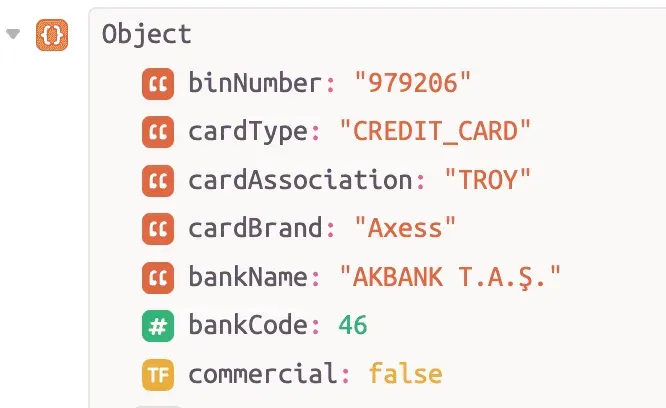
An up-to-date lookup can provide information such as the issuer, card network, funding type, card family, and whether the card is personal or commercial. This information helps merchants identify supported card characteristics within their payment flow.
Craftgate maintains a BIN/IIN lookup service using updated information from BKM and banks. The following illustration shows example response fields.
Payment Acceptance and Transaction Stages
POS: Point of Sale
POS refers to the point and associated hardware or software through which a merchant accepts payment. A physical card terminal is one familiar example of POS equipment used under the merchant's acceptance agreement.
Virtual POS or VPOS
A virtual POS is a software-based card acceptance connection used for online payments. The merchant's system sends payment requests and receives responses through the acquiring bank or provider's supported interface.
Mobile POS or mPOS
An mPOS solution enables payment acceptance using mobile devices such as smartphones or tablets, together with the appropriate software and supported acceptance equipment. The technical setup depends on the solution used.
Authorisation or Provision
Authorisation is the issuer's evaluation and approval or decline of a payment request. A successful authorisation can reserve the relevant amount against the card account. It is a stage in the payment process, distinct from the subsequent capture and settlement stages.
Pre-Authorisation or Pre-Auth
Pre-authorisation reserves an amount for later completion, for example, in a hotel booking, rental, or pre-order flow supported by the bank and provider. The final amount may be captured later, or the unused authorisation may be cancelled or expire according to the applicable conditions.
Capture, Completion, or Post-Auth
Capture submits an authorised payment for the next processing stages. Some bank integrations use terms such as completion or post-auth when finalising an earlier pre-authorisation. Timing, permitted amounts, and authorisation validity depend on the card scheme and provider setup.
Clearing and Settlement
Clearing involves the exchange and reconciliation of transaction information and obligations between the relevant payment participants. Settlement fulfils those financial obligations. The timing of funds reaching the merchant depends on the processing arrangements and merchant agreement.
End-of-Day Transactions and Batch Closing
End-of-day or batch-closing processes group or submit transaction records for further processing and reconciliation. Cut-off times and automatic or manual handling vary by acquirer, provider, and channel; they should be understood within the merchant's actual setup.
On-us
An on-us card transaction has the same issuing and acquiring institution. Its commercial treatment depends on the relevant agreement and payment arrangements.
Not-on-us
A not-on-us transaction has different issuing and acquiring institutions. Network and local clearing arrangements may apply between them. The merchant's fee depends on its acceptance agreement and market conditions, rather than a universal pricing rule.
Authentication, Validation, and Security
Luhn Algorithm
The Luhn algorithm is a mod-10 checksum used to detect many common card-number entry errors. Passing the checksum establishes mathematical consistency; the issuer and payment processing flow determine the card's status and the outcome of a transaction.
PIN: Personal Identification Number
A PIN is a secret numeric password used to verify the user, for example, in an ATM or supported card-present payment. The PCI SSC glossary distinguishes the PIN from a PIN block, which is a data structure used during processing.
OTP: One-Time Password
An OTP is a password generated for a single authentication event. It may be delivered through a supported channel such as SMS or used within an issuer's authentication process. It is separate from the card's printed or displayed security code.
3-D Secure
EMV 3-D Secure supports cardholder authentication for online card payments. The issuer can authenticate using transaction and device information through a frictionless flow or request an additional challenge, such as a one-time passcode, issuer-app approval, or biometric verification.
The required flow depends on the issuer, payment setup, transaction, and applicable rules. Debit or prepaid status alone should be interpreted together with the bank and provider's requirements when determining the supported authentication flow.
SSL, TLS, and HTTPS
Transport Layer Security (TLS) protects data in transit between communicating applications. SSL is the older protocol name still commonly used when referring to certificates. HTTPS is HTTP over a protected connection using TLS.
PCI and PCI SSC
PCI stands for Payment Card Industry. The PCI Security Standards Council (PCI SSC) is the organisation that develops payment security standards. These terms describe the industry and standards body respectively.
PCI DSS
The Payment Card Industry Data Security Standard sets technical and operational requirements for protecting payment account data. Its requirements apply according to the entity's handling of card data and its payment environment.
Card Storage
Card storage supports later payments without asking the customer to enter the same card details again. Craftgate's Tokenization solution uses private card storage within the merchant's own websites and applications, backed by PCI DSS Level 1 infrastructure. Stored-card references support eligible one-click and recurring payment flows through the merchant's contracted providers.
Fraud
Payment fraud involves deceptive or unauthorised activity intended to obtain financial gain through misuse of payment instruments, information, or systems. It can cause losses for cardholders, merchants, or financial institutions and may occur in physical or online transactions.
Chargeback
A chargeback is part of the card-network dispute process through which an issuer challenges a transaction, for example, following a cardholder's complaint about an unauthorised payment, amount, or service. The applicable reasons, evidence requirements, and procedures depend on the relevant scheme rules and circumstances.
Commercial Terms and Bank Transfers
Installments
Installments spread repayment over a schedule defined by the card or financing arrangement. The cardholder's payment schedule, merchant settlement, financing costs, and fees depend on the programme and commercial agreement.
As a hypothetical price example, an item priced at TRY 100 for a single payment might be offered at TRY 108 under a three-installment plan. An installment-at-cash-price offer keeps the purchase price unchanged. These figures illustrate the concepts rather than a current bank tariff.
Points, Bonus, and Chip Money
Card programmes may reward spending through points, bonuses, or similar balances that can be used under their earning and redemption rules. These arrangements may involve issuer campaigns and merchant participation.
Merchant commissions are determined separately by the applicable agreement. For illustration, a 2% commission on a TRY 100 purchase equals TRY 2. The commission and the cardholder's reward are separate amounts governed by their respective terms.
Bank and Wire Transfers
Bank transfer and wire transfer are broad terms for electronically transferring funds through banking arrangements. They can describe different domestic or international services depending on the market. Türkiye's local transfer terminology should be understood within that context.
EFT in Türkiye
Türkiye's Electronic Fund Transfer system supports Turkish lira interbank transfers and is operated by the Central Bank of the Republic of Türkiye (CBRT). It is a specific national payment system, within the wider category of electronic funds transfers.
FAST in Türkiye
FAST, the Instant and Continuous Transfer of Funds system, is operated by the CBRT independently of EFT. It supports eligible Turkish lira payments between participants around the clock, seven days a week.
Havale and Virman in Turkish Banking
Havale generally refers to a transfer between accounts within the same bank. Virman is commonly used for transfers between a customer's own accounts within the bank. The bank's terminology and service conditions determine the particular arrangement.
Payment Technologies and Digital Business Models
PSP: Payment Service Provider
A PSP provides payment services within its product and authorisation scope. Depending on that scope, services may include merchant acquiring, payment execution, or acceptance of supported electronic payment methods. A merchant's agreement with the provider defines the services and commercial conditions available to it.
Payment Gateway
A payment gateway provides technical connectivity for payment requests and responses between merchant systems and supported banks or payment providers. A shared integration can reduce the work involved in maintaining separate technical connections.
Payment Orchestration
Payment orchestration coordinates multiple provider connections and payment operations through a central technical platform. It combines integration with capabilities such as routing rules, monitoring, reporting, stored-card flows, and other supported services.
Craftgate applies merchant-defined commercial rules through Smart and Dynamic Payment Routing and manages virtual POS downtime through Autopilot. Payment Retry automatically retries transactions in eligible error groups through an alternative contracted provider. These capabilities support the merchant's payment setup and operational management.
Online or Digital Wallet
A digital wallet provides a way to use stored payment credentials or supported balances when making payments. Its funding and operating model varies: some wallets use linked cards or accounts, while others provide access to stored value. PayPal is one international example in markets where its services are available.
Mobile Wallet
A mobile wallet provides wallet functionality through a mobile device. Credentials or references may be managed through the device and associated services, enabling supported in-app, online, or in-person payment flows.
Alternative Payment Methods
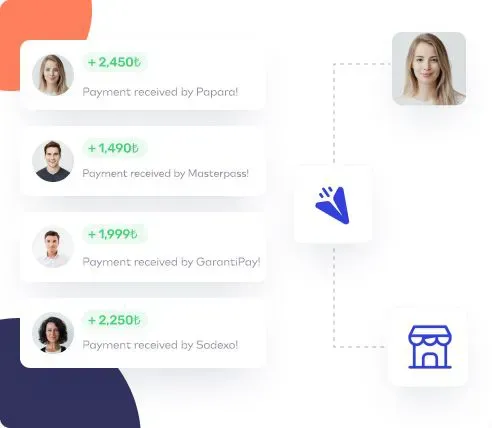
Alternative payment methods describe payment options beyond those treated as traditional in a particular market. They may include local wallets, bank-based methods, or other supported services. Payment links provide another way to present a payment journey to a customer.
E-Commerce Infrastructure Provider
An e-commerce infrastructure provider supplies capabilities such as storefront software, hosting, shopping-cart functions, or payment integrations. The features and responsibilities included depend on the service agreement and implementation.
Marketplace
A marketplace is a platform connecting multiple sellers with buyers of goods or services. It may provide product listings, checkout, customer interaction tools, and other shared capabilities. Seller fees and operating arrangements depend on the marketplace's business model.
Fintech
Fintech, short for financial technology, describes the use of technology to develop or improve financial products, services, and processes. It covers a broad range of business and technical activities.
Regulatory Concepts in Türkiye
Law No. 6493
Law No. 6493 sets the framework for payment and securities settlement systems, payment services, payment institutions, and electronic money institutions in Türkiye. Providing regulated payment services is a separate activity from a merchant obtaining a POS or payment acceptance service.
The CBRT publishes information on authorised payment institutions and their permitted service scope. Requirements should be assessed according to the activity and the relevant authorisation framework.
Open Banking
Open banking enables customer-consented access to account information and supported payment initiation through authorised services and technical interfaces. In Türkiye, the permitted service scope and consent requirements form part of the applicable payment-services framework.
Together, these concepts provide a foundation for understanding a merchant's payment environment. To discuss how Craftgate's technical integration and orchestration capabilities can support your business, contact our team.