Online reservations make it easier for customers to book travel, accommodation, dining, events, and activities. The payment step is an important part of that experience: customers need a clear way to complete their booking using a payment method that suits them.
For reservation businesses and online travel agencies (OTAs), offering different methods also creates integration and operational work. This guide explains the role of payment diversity in online reservations and how payment orchestration can help manage provider connections, commercial terms, and payment operations.
What Is Online Reservation?
An online reservation system enables customers to book services such as accommodation, bus, plane, or train travel, restaurant visits, cultural events, and sports activities through a website or application.
Customers enter the details relevant to their booking, and the business records that information in its reservation system. Confirmation details are commonly communicated by email or SMS. Where payment is part of the booking flow, its design and operational handling contribute to the overall experience.

Why Does the Payment Step Matter in Online Reservations?
Customer Experience and Convenience
A fast, understandable payment step helps customers complete their reservations. A complicated form, an unclear error, or an unavailable payment option can interrupt the process when they are ready to book.
This is particularly relevant on mobile devices, where the payment page should be simple to navigate and easy to use. For practical design recommendations, see our guide to reducing cart abandonment and boosting conversion rates.
Security and Customer Information
Customers need confidence in how their information is handled during payment. Secure payment interfaces, appropriate data handling, and the technical capabilities of the providers involved should be considered as part of the booking setup.
Stored cards can make repeat bookings more convenient when implemented through a suitable card storage solution. The security and integration model should be evaluated alongside the payment experience the business wants to offer.
Clear Cancellation and Refund Policies
Cancellation and refund conditions are important in reservations, especially for purchases such as flights, hotel stays, and travel packages that may involve substantial amounts. Customers should be able to understand the applicable conditions before completing payment.
Explain how customers can request a cancellation or refund, how they can follow its status, and where they can obtain support. Clear information helps reduce uncertainty and supports trust in the business.
Pre-Authorisation and Later Capture
Where supported by the bank and payment provider, hotels, car rental companies, and other reservation businesses can use pre-authorisation to reserve an amount on a customer's card. This places a hold on the amount; a separate capture finalizes the charge later.
For example, a hotel may use this flow as part of a deposit arrangement or for agreed accommodation and additional service charges, such as minibar expenses. The amount that can be captured, the validity of the authorisation, and the handling of an unused hold depend on the supported payment flow and the bank or provider's conditions.
Businesses should distinguish the hold from the subsequent charge when explaining the process to customers. For technical background on these stages, see the authorisation and capture documentation.

How Does Payment Method Diversity Support Online Bookings?
Reservation platforms serve customers with different payment habits. A domestic customer may look for card installments or a bank campaign, while an international traveler may prefer a familiar local wallet or another supported payment method.
Credit cards, debit cards, digital wallets, alternative methods, and buy-now-pay-later options can serve different needs. Their availability and terms depend on the market, provider, merchant agreement, and transaction involved. Our guide to online payment methods explains the main categories in more detail.
In its breakdown of abandonment reasons, excluding customers who were just browsing, Baymard's US e-commerce research lists insufficient payment methods at 9%. This general e-commerce finding provides context for reviewing the options offered during booking; it is not a reservation-industry-specific abandonment rate.
For OTAs operating across markets, relevant payment options can help create a more familiar checkout experience. Businesses can assess domestic and international provider agreements according to customer preferences, supported methods, and commercial conditions.
Offering more options also creates management work. Each provider may have a different API, technical configuration, maintenance process, and reporting interface. Payment orchestration helps coordinate these connections as the business expands its payment setup.

How Does Payment Orchestration Help Reservation Businesses and OTAs?
Reduce the Integration Burden
Integrating and maintaining separate payment connections can take considerable development time. Provider updates, troubleshooting, and differences between APIs add to the workload as the number of connections grows.
Craftgate's Payment Gateway gives merchants a single integration point for supported bank virtual POS systems, payment service providers, and alternative methods. The business selects the providers it is eligible and contracted to work with, while the platform coordinates the supported technical connections.
For businesses entering new markets, International Payment Methods can help extend this setup to supported providers and local payment options. This reduces the need to build a separate integration for every supported connection.
Manage Commercial Terms and Payment Commissions
Working with multiple banks or providers gives a business different commercial conditions to evaluate. Commissions, installment terms, and settlement arrangements can affect the cost of accepting reservations.
Craftgate's Smart and Dynamic Payment Routing applies predefined rules based on the merchant's commercial agreements and preferences. Payment requests can be routed through the most advantageous supported connection for the transaction, helping the business make use of the conditions available to it.
This becomes particularly relevant for travel businesses handling a high volume of bookings, where payment-related costs can accumulate across transactions.
Manage Downtime and Payment Retries
A technical interruption at the payment step can disrupt a booking and create uncertainty for the customer. Managing provider availability and payment responses helps businesses address these interruptions.
Autopilot monitors virtual POS connections for signs of downtime. When an outage is detected, incoming payment requests can be routed to an available alternative contracted connection according to the predefined setup.
Payment Retry automatically retries transactions in retry-eligible error groups through an alternative contracted payment provider.
Together, these capabilities help reduce technical interruptions that could otherwise prevent customers from completing a reservation.
Make Repeat Bookings Easier with Stored Cards
Repeat customers may prefer to complete a booking without entering their card details again. Stored-card payment flows can reduce this effort and support a more convenient checkout, including on mobile devices.
Craftgate's Tokenization solution supports private card storage for use within the merchant's own websites and mobile applications, backed by PCI DSS Level 1 infrastructure. Merchants can use stored-card references in supported payment flows through the providers they work with.
For travel agencies, this can help simplify repeat reservations and purchases of additional services. The merchant can design the booking experience around the supported stored-card integration.

Support Loyalty with a Closed-Loop Wallet
A closed-loop wallet can support repeat purchases within the reservation business's own environment. Customers can use eligible wallet balances for future bookings, upgrades, or additional services according to the merchant's terms.
Craftgate's Closed Loop Wallet solution provides the technical tools for merchants to manage customer wallet accounts, including refund balances, points, and campaign rewards. These options can help businesses connect their payment experience with loyalty initiatives.
For example, a travel agency can offer rewards for a later booking or make an eligible refund balance available for another purchase within its own ecosystem. Clear information about the balance and its use helps customers understand the options offered by the business.
Use Payment Analysis and Reports to Inform Strategy
Payment data helps reservation businesses understand transaction volumes, payment results, commissions, and refund patterns. Reviewing this information across providers can reveal recurring issues and opportunities to improve payment operations.
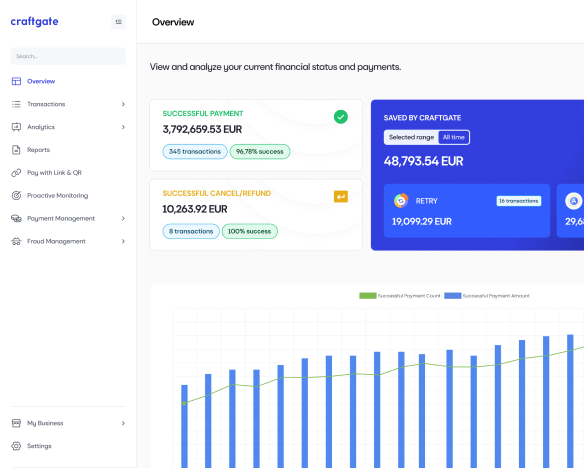
Craftgate's Advanced Merchant Panel brings payment statuses, provider details, and reporting into one dashboard. Teams can use this visibility alongside provider agreements and statements to review payment-related costs, including currency-related costs where relevant.
Monitoring payment conversion rates and investigating unsuccessful requests also helps teams evaluate their payment strategy. Reviewing suspicious activity and refund patterns can inform the use of Fraud Management tools and further investigation.
A clear view of payment activity supports a more informed online payment strategy as the reservation business grows.

Conclusion
Payment diversity is an important part of the online reservation experience. Relevant methods, a clear checkout, understandable cancellation conditions, and well-managed payment operations help customers move through the booking journey with greater confidence.
Payment orchestration helps reservation businesses and OTAs coordinate provider integrations, commercial routing rules, continuity tools, stored-card flows, closed-loop wallets, and reporting. Craftgate brings these technical capabilities together so merchants can manage their payment setup from a single platform.
To discuss the payment needs of your online reservation business and the integrations suited to your setup, contact our team.